 |
Debbie Fisher
Research Scientist
Calverton Center |
The 25th annual conference of the Society for Prevention Research (SPR), Prevention and Public Systems of Care: Research, Policy and Practice, was held in Washington, DC, on May 30-June 2, 2017. As a professional society, SPR reaches broadly across disciplines, including substance abuse, mental health, domestic violence, HIV/AIDS, criminal justice, health disparities, minority populations (racial/ethnic, sexual orientation), and more.
 Perhaps not surprisingly given the referenda across states in recent years, the issue of legalization of marijuana was one of the topics highlighted. As part of the first morning’s plenary session, Robert Doyle, Chair of the citizens’ coalition Colorado Smart Approaches to Marijuana, addressed the issue. He took the position that Big Tobacco is very actively involved in the fight for legalization and that the move toward passing medical marijuana laws was a strategy to set the stage for full legalization by normalizing recreational use. To bolster his argument, he pointed to the fact that rather than the whole unprocessed marijuana plant, medicinal use only requires cannabinoids, the chemicals in marijuana. As Colorado and other early-adopter states like Washington are providing experiments from which other states may learn, he closed with a call to action, noting that there has been no assessment of the costs of marijuana legalization in Colorado, despite the reported increases in marijuana-related traffic crashes, hospitalizations, and lost work. Ted, this sounds right up your alley!
In a session on late-breaking issues in substance use and abuse, an example of a serendipitous opportunity for research in the context of an ongoing longitudinal study was presented. Guided by Minority Stress Theory, researchers at the University of Washington decided to examine whether mental health issues (i.e., anxiety, depression) and alcohol use increased from pre- to post-election disproportionately among members of racial/ethnic minorities and those with minority sexual orientations, who were often the targets of controversial rhetoric and proposed policies and, thus, theorized to be more acutely experiencing threats from the election’s tenor. Results showed significant elevations in self-reported anxiety and depression but not drinking from the pre-test period (August-October 2016) compared to the post-test period (December 2016-February 2017) among minority populations compared to White and straight Americans.
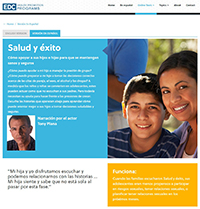 Salud y éxito program from the EDC Salud y éxito program from the EDC
Health Promotion Programs websiteAnother session presented novel parent education programs designed specifically for Latino parents and delivered on social media that help parents better understand what they can do to support healthy adolescents. For example, the program eHealth Familias Unidas is an internet adaptation of an evidence-based family intervention to reduce drug use and sexual risk behaviors among Hispanic adolescents. In a randomized controlled trial (RCT), positive effects were found for children’s drug use but not for condomless sex. Another speaker presented the results of the intervention Salud y Exito, also developed for Latino parents, that supports positive parenting practices presented via Facebook. An effectiveness study of an earlier version involving presenting the intervention via CDs and using an RCT demonstrated that youth whose parents received the CDs were less likely to report engaging in risky sexual behaviors, lifetime sex, and intentions to have sex in the following six months.
The day before the conference ended, Dr. George Koob, Director of NIAAA, gave his presidential address. Of particular interest to PIRE, Dr. Koob concluded his talk on the neurobiology of addiction by discussing the areas of interest to NIAAA. These included, among others, high-intensity/extreme binge drinking, drinking among older Americans, brief screening and interventions by physicians, neurobiopsychology studies, Fetal Alcohol Syndrome (FAS), alcohol and HIV/AIDS, and NIAAA’s Alcohol Treatment Navigator, a comprehensive, online resource of evidence-based programs for alcohol and other drug (AOD) treatment.
Other highlights of the conference included an opportunity to preview an upcoming HBO special developed in collaboration with NIAAA titled “Risky Drinking” and a PIRE reception at the Dubliner (moderate alcohol consumption only!). |